
Workbook
Más allá de la Ansiedad
A practical and compassionate workbook for understanding anxiety and developing tools for greater emotional calm.
Helping people understand themselves, find their strength, and move forward.
I believe that healing and learning begin when we feel understood. My work brings together psychotherapy, education, and practical tools for a more hopeful, grounded life.





I have always believed that two of the most powerful ways we can change a person's life are through education and human connection. As an educator and psychotherapist, I have had the privilege of helping people recognize strengths they may have forgotten they possessed.
My approach is warm, collaborative, compassionate, and practical. This is a space for hope, growth, and possibility.
Bienvenue. I'm very glad you're here. →A practical and compassionate workbook for understanding anxiety and developing tools for greater emotional calm.
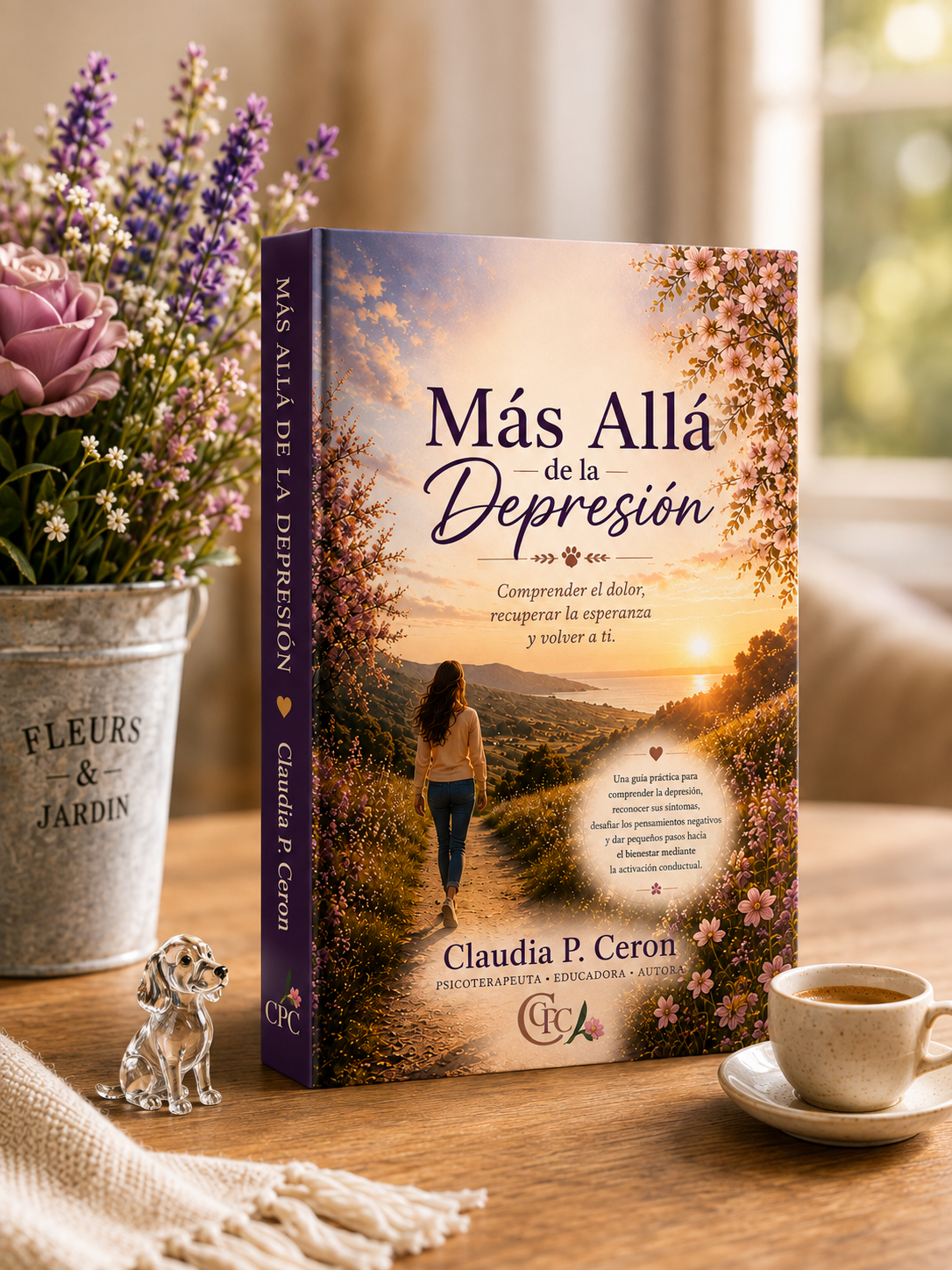
A practical guide to understanding depression, recovering hope, and returning to yourself.

“Growth doesn't always mean becoming someone new. Sometimes it means rediscovering the strength that was already there.”— Claudia P. Ceron
Making space for the worries beneath the worry—and a few gentle ways forward.
Read ArticleWords can make big experiences feel a little less lonely and a lot more manageable.
Read ArticleA compassionate reminder that growth rarely moves in a straight line.
Read ArticleInquiries for psychotherapy, resources, speaking, and collaboration are welcome.
Have you ever noticed how quickly anxiety can turn a small uncertainty into a frightening possibility?
A headache becomes “What if something is seriously wrong?”
A delayed response becomes “What if they are upset with me?”
A mistake at work becomes “What if I lose my job?”
Before we realize it, our minds have traveled far beyond what is actually happening and into everything that could happen.
This is one of the ways anxiety protects us—and also one of the ways it can exhaust us.
Anxiety is designed to alert us to potential danger. That ability is important. The problem begins when our internal alarm system becomes so sensitive that it reacts not only to actual danger, but also to uncertainty.
When that happens, our thoughts may begin predicting the worst possible outcome.
In Cognitive Behavioral Therapy, we often refer to this pattern as catastrophic thinking.
The thought may feel convincing because anxiety does not simply occur in our minds. Our bodies participate too.
Our heart may beat faster. Our breathing may change. Our muscles may tighten. We may experience nausea, dizziness, sweating, trembling, or pressure in our chest.
And when the body feels afraid, the mind often concludes:
“Something must be wrong.”
But a feeling is not always evidence.
And a thought—even a very frightening thought—is not automatically a fact.
When anxiety begins telling you the worst is going to happen, try not to immediately fight with the thought. Instead, become curious about it.
Ask yourself:
What am I afraid will happen?
Then ask:
What evidence do I have that this is happening right now?
And finally:
Is there another possible explanation?
For example:
“I haven't heard from my son. Something terrible may have happened.”
can slowly become:
“I haven't heard from him yet, and uncertainty is making me anxious. There are many ordinary reasons why he may not have answered.”
Notice that we aren't pretending everything is perfect. We're simply refusing to let anxiety write the ending before we have all the information.
Anxiety frequently lives in the future.
What if?
What if?
What if?
Mindfulness gently brings us back to a different question:
What is happening right now?
Feel your feet against the floor.
Slow your breathing.
Notice what you can see and hear around you.
Remind yourself:
At this moment, I am here.
Sometimes calming anxiety is not about finding absolute certainty. Life rarely gives us that. It is about learning that we can tolerate uncertainty without allowing fear to control every decision.
Pay attention to how you speak to yourself when you're anxious.
Would you tell someone you love:
“You're ridiculous. Stop worrying.”
Probably not.
So why speak to yourself that way?
Try:
“I'm feeling anxious right now. My mind is trying to protect me by imagining what could go wrong. I don't have to solve every possibility at this moment.”
Self-compassion does not make us weak or complacent. It helps create enough emotional safety for us to think more clearly.
Anxiety has an interesting way of making us feel smaller while making our fears appear enormous.
But anxiety is something you experience. It is not who you are.
Learning to manage anxiety takes knowledge, tools, patience, and practice. Some days will feel easier than others, and that is okay.
Progress doesn't require never feeling anxious again.
Sometimes progress is simply recognizing:
“I've felt this before. I know what this is. I have tools. I can move through it.”
And little by little, fear stops making every decision.
You begin making them again.
Adapted from themes explored in Más Allá de la Ansiedad, a therapeutic workbook by Claudia P. Ceron.
Claudia P. Ceron, M.A., NCC, LAC
Psychotherapist • Educator • Author
Sometimes children experience emotions that are much bigger than the words they have available to describe them.
A child may say:
“My stomach hurts.”
“I don't want to go to school.”
“Leave me alone!”
Or they may cry, yell, slam a door, become unusually quiet, or behave in ways that leave adults wondering:
What is going on?
After years of working with children in both educational and therapeutic settings, one thing has become very clear to me:
Behavior often communicates something a child does not yet know how to say.
Of course, children need limits.
Naming an emotion doesn't mean that hitting, screaming, disrespecting others, or breaking things suddenly becomes acceptable.
But correcting behavior without understanding what is underneath it can cause us to miss something important.
The child who says “I hate school!” may actually mean:
“I'm afraid I won't know the answer.”
The child who becomes angry when a parent leaves may be experiencing fear.
The child who refuses to participate may feel embarrassed.
The child who suddenly becomes quiet may be carrying sadness they don't know how to explain.
Sometimes what looks like anger is disappointment.
Sometimes what looks like defiance is anxiety.
Sometimes what looks like misbehavior is an overwhelmed child asking for help in the only language available to them.
One of the simplest things adults can do is help children develop an emotional vocabulary.
Instead of immediately asking:
“What's wrong with you?”
try:
“I noticed you became very quiet. Are you feeling sad, worried, embarrassed, or something else?”
For younger children, keep the choices simple.
You can use pictures, emotion cards, colors, stories, drawings, or even characters to help them identify what they feel.
A child might not be able to say:
“I am experiencing anxiety because I'm worried about being rejected by my classmates.”
But that same child may point to a worried face and say:
“That one.”
That's communication.
And that's a beginning.
I especially love using metaphors with children because metaphors make abstract feelings easier to understand.
Anxiety can become a noisy alarm.
Anger can become a volcano.
Difficult emotions can become a storm.
Negative thoughts can become a voice that says things that aren't always true.
Once the emotion has a name and an image, the child can begin observing it rather than simply being overwhelmed by it.
Instead of:
“I'm bad.”
we can help the child understand:
“I'm feeling really angry.”
Instead of:
“I can't do anything.”
we can explore:
“A worried thought is telling me I can't do it.”
That small change matters.
The child is no longer the problem.
The child is learning to understand the problem.
Adults sometimes worry that acknowledging children's feelings will reinforce unwanted behavior.
It doesn't have to.
We can say:
“I understand that you're angry. It's okay to be angry. It isn't okay to hit.”
Both statements can be true.
We are validating the emotion while maintaining the boundary.
Children need both.
They need adults who can say:
“I see your feelings.”
and also:
“I'm going to help you learn what to do with them.”
We don't expect children to understand multiplication before we teach it.
We don't expect them to read before they learn letters and sounds.
Yet sometimes we expect children to regulate fear, disappointment, frustration, jealousy, grief, and anger without ever explicitly teaching them how emotions work.
Emotional regulation is also learned.
We can teach children to notice what happens in their bodies, identify emotions, recognize thoughts, ask for help, breathe, take a break, solve problems, and express themselves without hurting themselves or others.
And just like every other skill, it requires repetition, patience, modeling, and practice.
I don't want children to believe that sadness, anger, anxiety, or disappointment are emotions they must eliminate.
Those feelings are part of being human.
Our job is to help children understand:
“I can have a big feeling without letting that feeling control everything I do.”
When children have words for their inner experiences, those experiences often become a little less frightening and a lot more manageable.
Sometimes one of the most powerful things we can give a child is not an answer.
It is the language to begin understanding what is happening inside.
Claudia P. Ceron, M.A., NCC, LAC
Psychotherapist • Educator • Author
We often imagine healing as a straight line.
Something hurts. We work on it. We begin feeling better. And eventually, we leave it behind.
I wish human beings worked that neatly.
We don't.
Healing can be messy.
You can have several good days and suddenly have a difficult one.
You can believe you've moved beyond something and unexpectedly find yourself crying about it again.
You can understand intellectually why something happened and still feel hurt emotionally.
You can make tremendous progress and still have moments when you wonder:
Why am I feeling this way again?
Those moments do not necessarily mean you've gone backward.
Sometimes we evaluate healing with one question:
“Do I feel better?”
But there are other ways to measure progress.
Maybe the situation that once overwhelmed you for an entire week now affects you for an afternoon.
Maybe you're setting a boundary you previously couldn't set.
Maybe you're recognizing a negative thought before automatically believing it.
Maybe you're asking for help.
Maybe you're getting out of bed when everything in you wants to stay there.
Maybe you're beginning to speak to yourself with a little more kindness.
Those things count.
In fact, sometimes the most meaningful progress happens quietly.
When we're struggling emotionally, we often wait to feel motivated before doing something.
I'll go for a walk when I feel better.
I'll call my friend when I have more energy.
I'll return to something I enjoy when I feel like myself again.
But sometimes healing works in the opposite direction.
The action comes first.
In behavioral activation, we recognize that small, intentional activities can gradually help reconnect us with pleasure, connection, accomplishment, and purpose.
That doesn't mean forcing yourself to pretend you're happy.
It can mean something as simple as opening the curtains.
Taking a shower.
Walking outside for ten minutes.
Preparing something to eat.
Calling someone you trust.
Returning to an activity that once mattered to you.
Small steps may look insignificant from the outside.
But when someone is hurting, small steps can require enormous courage.
There is another side of this conversation that we don't discuss enough.
Growth doesn't always mean doing more.
Sometimes caring for yourself means slowing down.
Resting.
Saying no.
Allowing yourself to grieve.
Asking for support.
Or simply speaking to yourself with more tenderness.
We live in a culture that often celebrates productivity, even during painful seasons of life. But healing is not another task we have to perform perfectly.
There is no prize for suffering efficiently.
Care for yourself with kindness, not demands.
Imagine climbing a mountain.
You stop and look back.
From where you're standing, you can see the path you've already traveled—the steep places, the turns, the moments when you weren't sure you could continue.
Then perhaps tomorrow you encounter another difficult hill.
That new hill does not erase the distance you've already traveled.
Neither does a difficult emotional day.
Healing can contain grief and gratitude.
Strength and exhaustion.
Progress and setbacks.
Hope and uncertainty.
Two things can be true at the same time:
“Today is difficult.”
and
“I am still moving forward.”
When we're focused only on how far we still have to go, it's easy to forget how far we've already come.
So every once in a while, look back.
Ask yourself:
What can I handle today that once felt impossible?
What have I learned about myself?
What boundaries have I developed?
What am I doing differently?
Where have I become kinder to myself?
You may discover that progress was happening during moments when you couldn't see it.
Perhaps healing isn't always about becoming a different person.
Sometimes it is about returning to yourself with greater understanding.
Recognizing your needs.
Learning from what you've survived.
Rediscovering strengths that pain temporarily made difficult to see.
And allowing yourself to believe that there can still be meaningful chapters ahead.
The progress may not always be obvious from one day to the next, but every small step counts.
Keep going.
Not perfectly.
Not quickly.
At your own pace.
Inspired by themes explored in Más Allá de la Depresión, a therapeutic workbook by Claudia P. Ceron.
Claudia P. Ceron, M.A., NCC, LAC
Psychotherapist • Educator • Author